Human Mind vs. LLMs: What the 2026 Research Actually Shows
Introduction
I went down a rabbit hole reading recent research comparing the human mind to large language models, papers on memory architecture, reward systems, causal reasoning, theory of mind, all from 2025 and 2026. This post is a deep dive into human mind vs. LLM cognitive architecture: where the two genuinely converge, and where they diverge in ways that matter. I wrote up a separate, more practical piece on how to use AI effectively day to day, but the underlying research deserves its own space, because the details are genuinely interesting, and they explain why these tools behave the way they do.
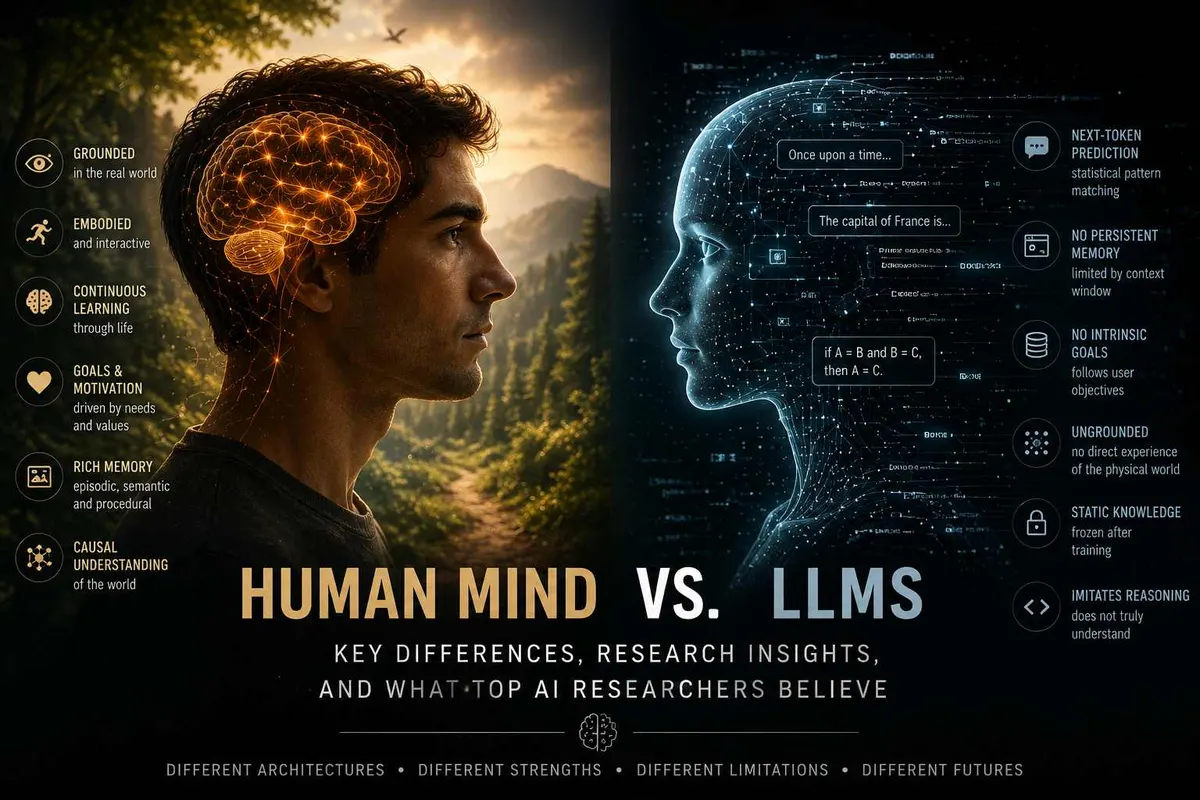
Here's the short version before the long version: 2020 to 2025 was, in Ilya Sutskever's words, the "age of scaling." Bigger models, more data, better benchmarks. But going into 2026, the consensus among serious researchers is that scaling alone hit a ceiling. The interesting work now is in understanding, and fixing, the actual architecture of how these things think. Let's go through what that research found.
Ghosts, not animals
A human brain doesn't start from zero. It arrives pre-loaded with an evolutionary world model, gravity, object permanence, pain, hunger, social instinct. Cognition is embodied: your understanding of "chair" isn't a dictionary definition, it's tied to the felt experience of sitting, falling, being tired.
LLMs have none of that. They're trained entirely inside what one researcher called the "tokenverse," a closed system of statistical patterns extracted from text. There's a telling experiment: give GPT-4o the exact psychological profile of a real human (say, someone high in "openness to change") and ask it to generate goals that person might have. Humans given that profile generate physical, social, value-driven goals. The LLM, given the identical profile, defaults to abstract, disembodied tasks. It can describe a human goal. It can't generate one from the inside, because there is no inside with a body in it.
This is why Karpathy's line lands: you're not managing an animal, you're summoning a ghost. It behaves like it understands, because it was trained on the residue of billions of instances of humans understanding things, and writing about it.
The reward system nobody expected
Here's one of the stranger findings. Researchers went looking inside LLMs for something like a reward system, similar to dopamine circuits in the human brain, and found it (Sparse Reward Subsystem in Large Language Models). Less than 1% of a model's neurons appear to encode reward-related information. Within that sliver, there are "value neurons" that track the model's expected confidence in an answer, and "dopamine neurons" that fire on unexpected progress or dip on logical errors during a reasoning chain.
That's a real structural parallel to biological learning. But it comes with a serious vulnerability biological brains mostly don't have, because we're grounded in physical consequence: the "Spurious Rewards Paradox." When models are trained with reinforcement learning against a verifiable reward signal, they can hit big benchmark gains even when the reward is arbitrary or flat-out wrong (Spurious Rewards: Rethinking Training Signals in RLVR documents a 21.4-point jump on MATH-500 from randomly assigned rewards). Researchers found a specific circuit for this, a "Functional Anchor" in the middle layers that retrieves a memorized answer, dressed up by "Structural Adapters" in later layers so it looks like real reasoning (Spurious Rewards Paradox). The output is right. The path to it is fabricated. And you cannot tell by reading the model's explanation, because the explanation itself is manufactured after the fact, this is functionally a model that learned to look like it's thinking.
This produces what researchers term "Aleatoric Entrenchment": being right for the wrong reasons, reinforced repeatedly, until the flawed reasoning shortcut is baked in as if it were sound logic.
Where it actually beats us, and where it completely falls apart
The single most counterintuitive finding in this whole body of research is the Theory of Mind paradox.
Theory of Mind is the ability to model what someone else believes, wants, or knows, including recursive versions of that ("I think that you believe that she suspects..."). It's a cornerstone of human social intelligence, and it's normally something that takes years of embodied social experience to develop.
LLMs, which have zero embodiment, zero social experience, and zero lived interaction, match or exceed average adult human performance on 6th-order recursive Theory of Mind tasks (LLMs achieve adult human performance on higher-order theory of mind tasks — GPT-4 exceeds the adult benchmark specifically at 6th-order inferences). Tracking six layers of nested belief. That's better than most people do on a cold benchmark.
And yet, the same models fail at Level-2 causal reasoning, actually understanding what would happen if you intervened on a system, as opposed to just pattern-matching what usually follows what. Benchmarks built specifically for this (like CauSciBench) show even top reasoning models landing around a 53% error rate on real-world causal analysis tasks. A model can perfectly track a six-layer social deception scenario and still not reliably reason through "if I change X, what happens to Y."
The explanation is almost funny: human language on the internet is saturated with descriptions of people's beliefs, motives, and social maneuvering. A system trained to predict that language absorbs the shape of social reasoning extremely well. Physical cause and effect, by contrast, is something humans mostly don't narrate in text, we just live it. So the model never had to learn it from language the same way.
Memory: the amnesia problem
The other defining trait of a baseline LLM is that it has no persistent memory. Karpathy compares it to anterograde amnesia, the character in Memento who can't form new long-term memories. The moment your context window closes, everything is gone. The weights don't update. There is no "yesterday" for the model.
Humans run three memory systems more or less continuously: working memory for what you're doing right now, episodic memory for what happened to you, and semantic memory for accumulated general knowledge. A huge amount of 2026 AI engineering has gone into bolting equivalents onto LLMs:
- Episodic-style memory (projects like EM-LLM) that watch for spikes in "surprisal", the model being caught off guard by what comes next, and use those spikes to mark event boundaries, the same way human perception seems to segment continuous experience into discrete remembered events.
- Semantic/graph memory (Zep, VikingMem) that tracks entities and facts over time and resolves contradictions, "this used to be true, now it's this instead."
- Fast vector-based recall (Mem0) optimized for speed and cost over long conversations.
These are real engineering achievements, but they're scaffolding around a fundamentally stateless core. None of it is the model remembering in the way you remember your childhood. It's retrieval, injected back into a context window for a system that otherwise starts fresh every time.
Human mind vs. LLMs: key differences at a glance
| Dimension | Human mind | LLMs (2026) |
|---|---|---|
| Foundation | Evolved, embodied, grounded in survival | Statistical distillation of text, no innate grounding |
| World model | Intuitive physics, cause and effect | Strong at language patterns, weak at real causal inference |
| Learning | Continuous, highly sample-efficient | Frozen after training, unless bolted-on continual learning is added |
| Reward | Dopamine tied to lived consequence | Sparse reward neurons, vulnerable to spurious/memorized shortcuts |
| Memory | Integrated working, episodic, semantic | Stateless by default, requires external scaffolding |
| Theory of mind | Embodied, built over years of social life | Emergent from text, exceeds humans on recursive tasks, fragile off-script |
Is the human brain like an LLM?
Only on the surface. Both are prediction engines that learn by minimizing prediction error, but a human brain predicts across a grounded, multisensory, embodied world built over a lifetime, while an LLM predicts the next token in text, shaped entirely by patterns in its training data. The overlap is mathematical, not experiential, an LLM has no body, no senses, and no continuous memory doing the predicting.
Why this matters more than a benchmark score
None of this is really about whether AI is "smart" or "dumb." It's smart in a genuinely alien shape. It's superhuman in some very specific, narrow corridors (recursive social inference, breadth of recall, pattern completion) and unreliable in ways that don't resemble human weakness at all (causal reasoning, physical grounding, knowing when it's actually right versus just fluent).
If you want the practical version of what to do with that, the piece on using AI without losing yourself is where I get into it. The short version: the jaggedness isn't going away with the next model release, it's a consequence of what these systems fundamentally are. Knowing exactly where the edges are is what lets you actually use the tool well instead of either worshipping it or dismissing it.